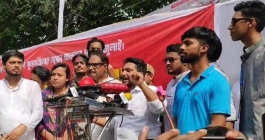

This past week, the news cycle in Bangladesh was split between the scorching heat, the boiling streets, and the equally heated narratives beamed from television screens and printed on front pages. As temperatures soared, so did public frustration, culminating in a nationwide student uprising demanding quota reforms. But as our monitoring shows, what citizens saw and read depended heavily on which channel they tuned to or which newspaper they picked up.
THE BIG STORY: TWO VERSIONS OF ONE UPRISING
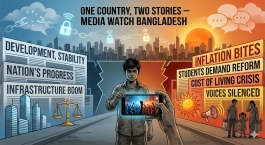
The student movement for the reform of the quota system in government jobs was, without dispute, the week’s dominant story. Yet, it was framed in two strikingly different ways.
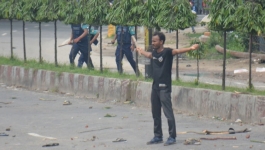
On one side, independent online portals and several major dailies like The Daily Star and Prothom Alo ran headlines such as “Students Vow to Continue Fight for Meritocracy” and “Campuses Erupt in Peaceful Demand for Reform.” Their coverage was saturated with live updates, photographs of determined students, and detailed explanations of their demands. Social media feeds, particularly on Facebook and X, were flooded with user-generated footage of protests, songs, and, later, scenes of police action.
Flip to several pro-government television channels and newspapers, and the narrative shifted. Initial reports were scant. As the protests grew, the framing turned to “Academic Activities Disrupted by Chaos” and “Police Urge Restraint as Agitators Block Highways.” The focus was on public inconvenience and the potential for disorder, often quoting government officials who warned against “destructive elements” hijacking a genuine grievance.
This bifurcation provided a textbook case of how a single event can become two separate realities for the public, deepening the existing political chasm.
THE BACKDROP: THE RELENTLESS ECONOMIC SQUEEZE
Beneath the protests, the relentless story of economic hardship continued. Front-page business sections were unanimous on the top concern: food inflation. Reports of egg and poultry prices hitting new highs were ubiquitous. However, the tone of the reporting diverged.
Government-aligned outlets prominently featured stories on the Trading Corporation of Bangladesh (TCB) selling essentials at subsidized rates and cabinet meetings discussing market monitoring. The narrative leaned on state action. In contrast, independent economic analyses and human-interest features delved into families skipping meals, the rising cost of Ramadan iftar, and critiques of what was termed inadequate policy responses. The verdict in the Hallmark-Sonali Bank loan scam was a grim reminder, covered extensively but with a sense of resigned cynicism about accountability.
THE SILENT PRESSURE: JOURNALISTS ON A TIGHTROPE
While the streets and the economy roared, a quieter but critical story unfolded in newsrooms. Our monitoring documented a tangible climate of caution.
In Khulna, a journalist confided to our network about receiving a verbal threat of a case under the Cyber Security Act (CSA) for a report on local government corruption. In Dhaka, several reporters covering the student protests at Shahbagh reported being physically turned away by law enforcement from entering key points. “We were told it was for our own safety, but it effectively blocked our access,” one reporter stated on condition of anonymity.
Online, journalists and pages amplifying protest footage faced coordinated harassment, branded as “anti-state” and “provocateurs” by partisan social media accounts. This created an invisible filter, a form of soft censorship, where the risk of legal hassle or online vilification influences what gets pursued and published.
THE DISINFORMATION FOG
In the chaos, misinformation thrived. Our fact-checking desk identified and debunked several viral claims:
A fabricated quote from a student leader allegedly inciting violence.
Recycled video from 2018 protests being shared as “current police brutality.”
False claims about the total abolition of quotas, distorting the students’ core demand for reform.
These falsehoods, spread primarily on social media, aimed to discredit the protesters and stoke further division.
THE BOTTOM LINE
This week underscored that the Bangladeshi media is not just a recorder of events but an active arena where the nation’s political and social battles are fought. The student protests held up a mirror, revealing deep fractures in how reality is portrayed. The public is left to navigate a landscape where the story of their own struggle is told in conflicting chapters, all while the watchdogs meant to report the truth often find themselves muzzled, watching their step.